
DnD Loot Generator
Enter the creatures you defeated, or a hoard's challenge rating, and roll the treasure.
| Tier | Challenge rating | Coins per creature | Average |
|---|---|---|---|
| 1 | 0–4 | 3d6 GP | 10.5 GP |
| 2 | 5–10 | 2d6 × 10 GP | 70 GP |
| 3 | 11–16 | 2d6 × 100 GP | 700 GP |
| 4 | 17+ | 2d6 PP | 7 PP |
| Tier | Challenge rating | Coins | Average | Magic items | Chance of each rarity |
|---|---|---|---|---|---|
| 1 | 0–4 | 2d4 × 100 GP | 500 GP | 1–3 | Common 60%, Uncommon 30%, Rare 10% |
| 2 | 5–10 | 8d10 × 10 PP | 440 PP | 1–4 | Uncommon 50%, Rare 40%, Very Rare 10% |
| 3 | 11–16 | 8d8 × 100 PP | 3,600 PP | 1–4 | Rare 50%, Very Rare 40%, Legendary 10% |
| 4 | 17+ | 6d10 × 1,000 PP | 33,000 PP | 1–4 | Very Rare 50%, Legendary 50% |
Recent
Your last 10 settings, saved only in this browser. Nothing is uploaded.
How to use the Loot Generator
- Choose a Kind of treasure: Individual treasure or Treasure hoard.
- For individual treasure, set the Challenge rating of group for a group of creatures.
- Set the Number of creatures in group (1 to 40).
- Click Add creatures to add the group. Repeat for each group in the encounter. Click Remove to delete a group.
- For a treasure hoard, choose the Highest CR in the encounter and the Number of hoards (1 to 5).
- Click Roll again to generate new loot. Each roll gives different results.
- Type a value in the Seed box if you want a specific, repeatable result.
- Read the result. Coins appear in their own units, and about N GP in all converts coins and item values to gold.
You can use Copy text to copy the loot, Print to open the item text for printing, or Copy link to share the result. The seed in the link reproduces the same loot for anyone who opens it.
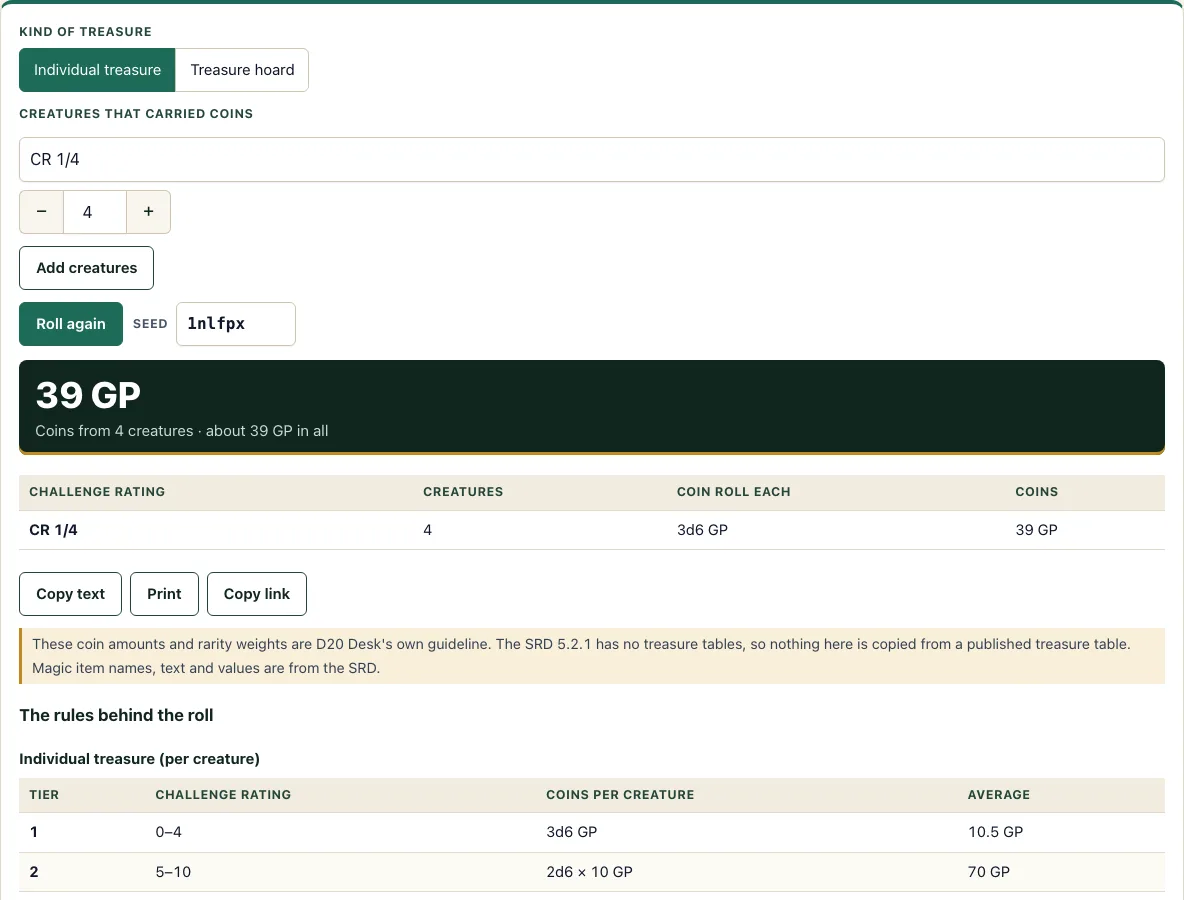
The page opens on Individual treasure with one group of four CR 1/4 creatures, so a result is already showing when you arrive. Switch to Treasure hoard to roll coins and magic items for the whole encounter, and use the rule tables under the result to see exactly which dice produced each amount.
How much treasure should a party get?
The tool does not work from a single party budget. Each creature rolls its own coins based on its challenge rating (CR), so more creatures and higher CRs mean more treasure. The coin rolls are D20 Desk’s own guideline values, not a published rule.
- Tier 1 (CR 0 to 4) rolls 3d6 GP, averaging 10.5 GP per creature.
- Tier 2 (CR 5 to 10) rolls 2d6 x 10 GP, averaging 70 GP per creature.
- Tier 3 (CR 11 to 16) rolls 2d6 x 100 GP, averaging 700 GP per creature.
- Tier 4 (CR 17 and up) rolls 2d6 PP, averaging 7 PP per creature.
To change the total, adjust the group sizes and CRs in the encounter.
Does the SRD have treasure tables?
No. The SRD 5.2.1 does not contain treasure tables. The coin amounts and rarity chances on this page come from D20 Desk’s own guideline, and the page says so and shows the tables. The magic items that can appear in hoards are real SRD magic items, with their full text and value.
What is the difference between individual treasure and a hoard?
Individual treasure is what each creature carries. Every creature in each group rolls its own coins using the tier for its CR, and no magic items are rolled.
A hoard is a larger stash set by the highest CR in the encounter, and you can have up to five hoards. Each hoard rolls its own coins and magic items:
- Tier 1 coins: 2d4 x 100 GP, averaging 500 GP.
- Tier 2 coins: 8d10 x 10 PP, averaging 440 PP.
- Tier 3 coins: 8d8 x 100 PP, averaging 3,600 PP.
- Tier 4 coins: 6d10 x 1,000 PP, averaging 33,000 PP.
Tier 1 hoards get 1 to 3 magic items. Tiers 2 to 4 get 1 to 4 items. The rarity of each item depends on the tier:
- Tier 1: Common 60%, Uncommon 30%, Rare 10%.
- Tier 2: Uncommon 50%, Rare 40%, Very Rare 10%.
- Tier 3: Rare 50%, Very Rare 40%, Legendary 10%.
- Tier 4: Very Rare 50%, Legendary 50%.
How are magic item values worked out?
An item’s value comes from its rarity: Common 100 GP, Uncommon 400 GP, Rare 4,000 GP, Very Rare 40,000 GP, and Legendary 200,000 GP. Two rules change this. Consumables other than spell scrolls are worth half the rarity value, and spell scrolls are worth twice their scribing cost.
Artifacts and items whose rarity varies have no fixed value, so the tool shows none for them.
The result keeps coins in their own units, so 440 PP stays 440 PP. The “about N GP in all” figure converts everything to gold using 1 PP = 10 GP, so 440 PP becomes 4,400 GP.
Frequently asked questions
Is the Loot Generator free to use?
Yes. It is free, and you do not need an account or sign-up. Everything runs in your browser, and nothing is uploaded.
Can I get the same loot again?
Yes. Enter a value in the Seed box, or use Copy link. The seed in the link reproduces the same loot. Click Roll again to get a new result.
Are the magic items from the SRD?
Yes. The items are real SRD 5.2.1 magic items, with their full text and value.
Why does an item show no value?
Artifacts and items whose rarity varies have no fixed value in the SRD value rules, so the tool shows none.
Are the coin amounts from a published treasure table?
No. The SRD 5.2.1 has no treasure tables. The coin amounts and rarity chances are D20 Desk’s own guideline, and the page says so.
Is this the same as the treasure generator?
Yes. “Treasure generator” and “loot generator” are the same tool.
Can I roll several hoards at once?
Yes. In hoard mode, set Number of hoards from 1 to 5, and each hoard gets its own coins and magic items. They share one seed, so the link reproduces all of them.
Can I use generated loot commercially?
Yes. Treasure you roll is yours, and you may use it commercially, for example as treasure tables in a product you sell. See the terms.
Related tools
- Magic item generator: Use it when you need a single magic item rather than a full hoard.
- Random encounter generator: Use it to pick the creatures that might carry the loot you roll.
- Encounter calculator: Use it to check how hard the fight is before you decide how much treasure to add.
- Shop generator: Use it when your players want to buy items rather than find them.
- XP chart: Use it to look up experience points for the creatures the party defeats.
- DM screen: Use it to keep common rules and tables close at hand during play.