
DnD Languages
See the standard and rare language tables or roll new languages on the d12 table, skipping the ones you know.
Recent
Your last 10 settings, saved only in this browser. Nothing is uploaded.
How to use the Language Roller
- Set Languages to roll to a number from 1 to 9.
- Optional: type a value in the Seed box if you want to be able to reproduce a result.
- Under Already known, tick each language your character already has. Ticked languages are skipped, so they are never rolled.
- Click Roll languages.
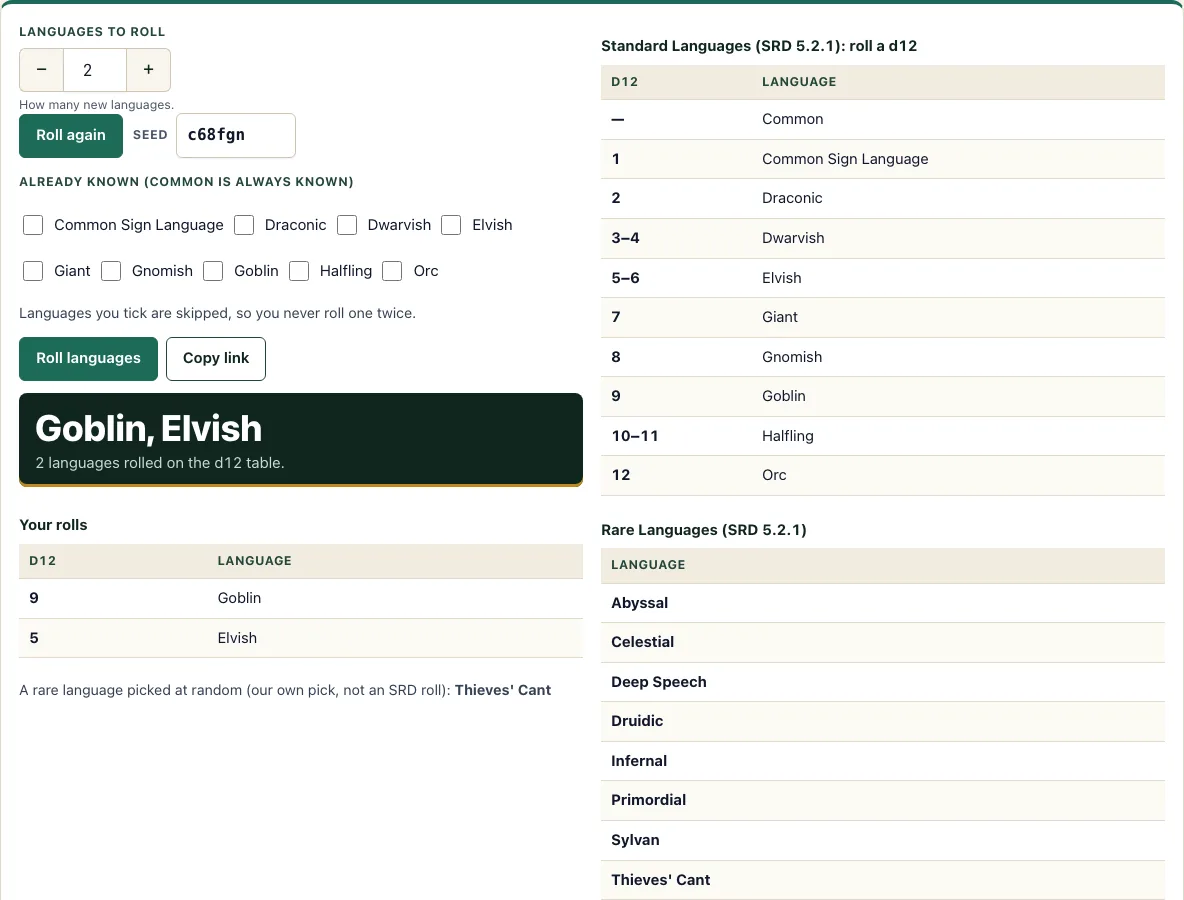
- Read the result. Each language shows the d12 roll that produced it. For example, a roll of 4 gives Dwarvish, because 3-4 is Dwarvish. If a roll hits a language you already know, the tool rolls again. If fewer languages are left than you asked for, the page says so.
- Check the rare language picked below the result. It changes whenever the seed changes.
- Press Roll languages again for a new set; each press picks a new seed and a fresh result.
- To compare a roll with the table, look at the Standard Languages table on the right: the d12 number in your result matches a row there.
Click Copy link to save your seed, count and known languages in the address. Anyone who opens the link sees the same setup. The buttons are large, and the layout fits a 375 px phone screen, so you can use the tool on a phone.
What are the standard languages?
The standard languages are the ones in the SRD 5.2.1 Standard Languages table, which you roll on a d12. Each face maps to one language: Common Sign Language on 1, Draconic on 2, Dwarvish on 3 and 4, Elvish on 5 and 6, Giant on 7, Gnomish on 8, Goblin on 9, Halfling on 10 and 11, and Orc on 12. Common is listed without a die number. It is the language every character knows, so it is never rolled.
Because the table uses a d12, the odds are uneven. Dwarvish, Elvish and Halfling each cover two faces, so each has a 1 in 6 chance on a single roll. The other six languages cover one face each, a 1 in 12 chance. The roller uses the table as written, so these odds apply to every roll.
What are the rare languages?
The rare languages are a separate SRD list with no die attached. They are Abyssal, Celestial, Deep Speech, Druidic, Infernal, Primordial, Sylvan, Thieves’ Cant and Undercommon.
Primordial is a special case. It includes the Aquan, Auran, Ignan and Terran dialects, and creatures that know one dialect can talk with creatures that know another. The random rare language shown below each result is picked by this page from the same list. It is not an SRD table roll, because the rare list has no die.
How does the roller avoid repeats?
Each roll is a d12 on the Standard Languages table. If the roll lands on a language you already know, or one the roller has already given you in this result, it is thrown away and rolled again, so you never get the same language twice. Common is always counted as known. Tick a language under Already known and it is skipped in the same way.
The roller works from the seed shown in the Seed box. The same seed, count and known languages always give the same result, which is why the link can share a roll. Press Roll languages for a new seed, or type your own to repeat an earlier result. The rolled languages appear in a table with the d12 roll next to each one, so you can check them against the SRD table on the right.
Frequently asked questions
What languages are in 5e?
The SRD 5.2.1 names Common, nine languages on the d12 table, and nine rare languages. The standard list covers the languages a character can roll for, while the rare list covers more specialised tongues such as Druidic and Thieves’ Cant.
How many languages does a character know?
In the SRD 5.2.1 (p.20), a character knows Common plus two other languages chosen from the Standard Languages table. Your DM may allow other languages, and backgrounds and species can add more.
Is Common a language everyone speaks?
Common is the language every character knows, so it is not part of the d12 roll.
Why does Dwarvish, Elvish or Halfling come up more often?
Those three languages each cover two faces of the d12, so each has a 1 in 6 chance on a single roll. The other standard languages each have a 1 in 12 chance.
What happens if I ask for more languages than are left?
The tool tells you when fewer languages remain than you asked for. Ticking more languages under Already known leaves fewer choices, so reduce the count or untick a language to get a full result.
Does the tool show who speaks each language or what script it uses?
No. The tool shows language names only. It does not list typical speakers or scripts.
Can I use the language roller results commercially?
Yes. What you roll or print is yours for any purpose, including commercial use, such as a language table in a paid supplement. See the terms.
Related tools
- Character creator: build a full character once you have chosen your languages.
- Character sheet: record your character’s languages and other details in one place.
- Stat roller: roll ability scores for the same character.
- Dice roller: roll any dice you need for your game.
- Point buy calculator: spend a fixed pool of points on ability scores.
- Class quiz: find a class that fits how you like to play.
- Alignment test: place your character on the nine-alignment chart.
- Spell list: browse every SRD spell by class, level and school.