
DnD Jump Calculator
Enter a Strength score to see how far and how high you can jump, with and without a running start.
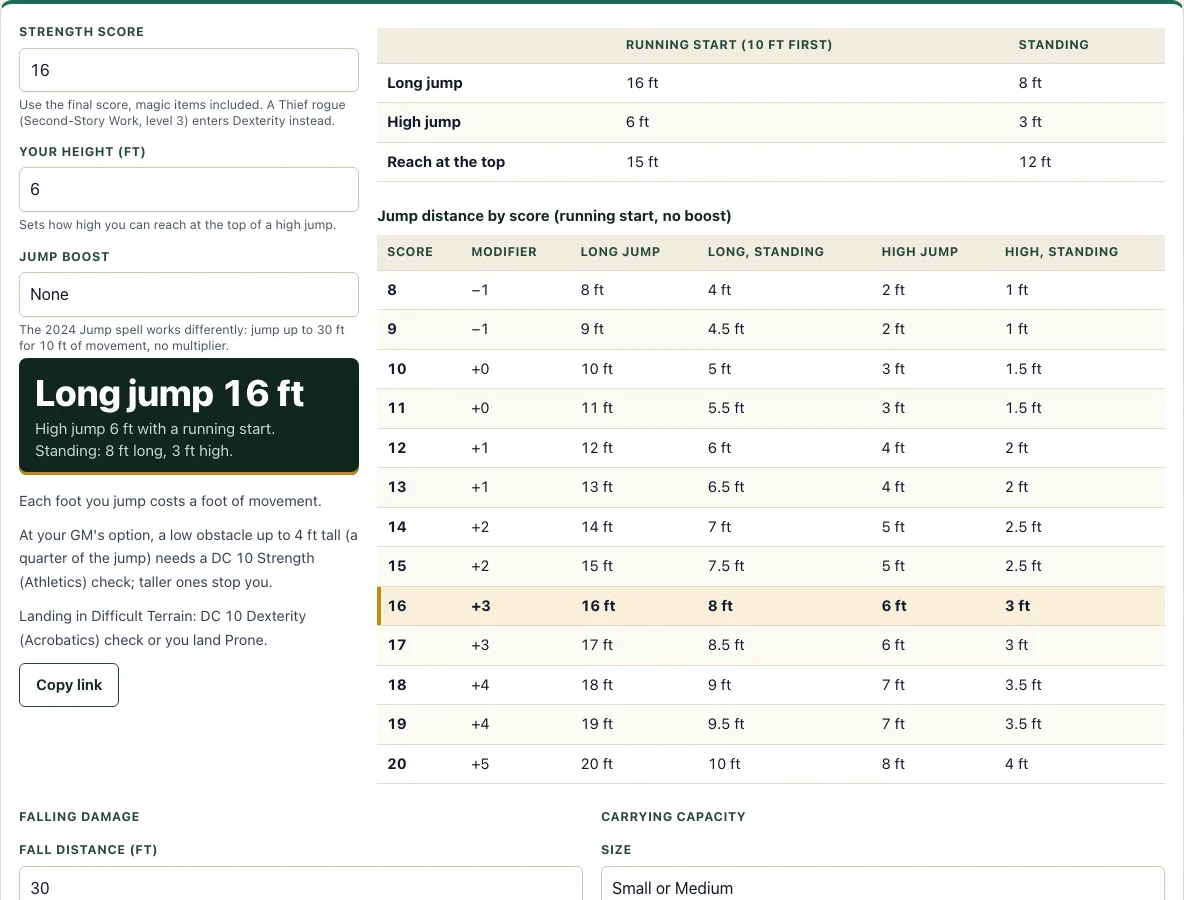
| Score | Modifier | Long jump | Long jump, standing | High jump | High jump, standing |
|---|---|---|---|---|---|
| 8 | −1 | 8 ft | 4 ft | 2 ft | 1 ft |
| 9 | −1 | 9 ft | 4.5 ft | 2 ft | 1 ft |
| 10 | +0 | 10 ft | 5 ft | 3 ft | 1.5 ft |
| 11 | +0 | 11 ft | 5.5 ft | 3 ft | 1.5 ft |
| 12 | +1 | 12 ft | 6 ft | 4 ft | 2 ft |
| 13 | +1 | 13 ft | 6.5 ft | 4 ft | 2 ft |
| 14 | +2 | 14 ft | 7 ft | 5 ft | 2.5 ft |
| 15 | +2 | 15 ft | 7.5 ft | 5 ft | 2.5 ft |
| 16 | +3 | 16 ft | 8 ft | 6 ft | 3 ft |
| 17 | +3 | 17 ft | 8.5 ft | 6 ft | 3 ft |
| 18 | +4 | 18 ft | 9 ft | 7 ft | 3.5 ft |
| 19 | +4 | 19 ft | 9.5 ft | 7 ft | 3.5 ft |
| 20 | +5 | 20 ft | 10 ft | 8 ft | 4 ft |
Free · runs in your browser · nothing is uploaded
Recent
Your last 10 settings, saved only in this browser. Nothing is uploaded.
How to use the D&D Jump Calculator
The default Strength score is 16, so the results appear as soon as the page loads. Change the fields below to match your character.
- Type your character’s Strength score into the Strength score field. It accepts 1 to 30.
- Enter your height in the “Your height (ft)” field. It starts at 6 and sets the reach at the top of a high jump.
- Open the Jump boost menu and pick None, Step of the Wind (Monk): x2, or Jump spell, 2014 version: x3. A note under the menu explains that the 2024 Jump spell works differently and has no multiplier.
- Read the large “Long jump N ft” line. The line below it gives the high jump with a running start, plus the standing long and high jump.
- Check the Running start / Standing table for the long jump, high jump and reach at the top.
- Scroll to the score table for scores 8 to 20. Your current score row is highlighted.
- If your character is a Thief rogue, type your Dexterity score into the score field instead.
- Use the Falling damage and Carrying capacity tools below the results when you need them.
All settings are kept in the page address. Copy link copies that address, so anyone who opens it sees your numbers.
How do you calculate jump distance in D&D 5e?
The long jump equals your Strength score in feet if you move at least 10 feet on foot right before jumping. A standing long jump is half that. The high jump equals 3 plus your Strength modifier, with a minimum of 0 feet, and a standing high jump is half that.
The calculation follows a short sequence:
- Find your Strength score and its modifier.
- For a running long jump, use your Strength score in feet. Halve it for a standing long jump.
- For a running high jump, add 3 to your Strength modifier, with a minimum of 0 feet. Halve that for a standing high jump.
- For the reach at the top of a high jump, add 1.5 times your height to the jump distance.
- Count each foot jumped against your movement, since each foot costs a foot of movement.
A Strength 8 character has a -1 modifier. That gives an 8 foot running long jump and a 2 foot running high jump. Thief rogues with Second-Story Work use Dexterity in place of Strength for jump distance, which is why the tool accepts a Dexterity score in the same field.
How far can I jump with a Strength of 16?
A Strength 16 character can long jump 16 feet and high jump 6 feet after a running start. Standing, those numbers drop to 8 feet and 3 feet. For a character who is 6 feet tall, the reach at the top of a running high jump is 15 feet.
| Measure | Running start | Standing |
|---|---|---|
| Long jump | 16 ft | 8 ft |
| High jump | 6 ft | 3 ft |
| Reach at the top (6 ft tall) | 15 ft | 12 ft |
The standing reach of 12 feet follows from the same reach rule, using the standing high jump of 3 feet. Strength 16 gives a +3 modifier, which is where the 6 foot running high jump comes from.
Jump distance by score
Each point of Strength adds one foot to the running long jump, so the long jump runs from 8 feet at Strength 8 to 20 feet at Strength 20. The high jump grows more slowly because it follows the modifier: 2 feet at Strength 8, 5 feet at Strength 14, 6 feet at Strength 16 and 8 feet at Strength 20. The score table under the calculator lists every score from 8 to 20 with both jumps, standing and running.
What happens when you land or meet an obstacle?
If you land in Difficult Terrain after a long jump, you must succeed on a DC 10 Dexterity (Acrobatics) check or end up Prone. At the GM’s option, clearing a low obstacle no taller than a quarter of the jump’s distance needs a DC 10 Strength (Athletics) check, and a failure means you hit it. A Strength 20 character with a 20 foot long jump could clear a 5 foot wall this way. Since each foot jumped costs a foot of movement, a jump can never be longer than the movement you have left.
How this tool works and where the numbers come from
Long Jump is the Strength score in feet and High Jump is 3 plus the Strength modifier (minimum 0) in feet, both after a 10 ft run; a standing jump is half. Reach adds one and a half times your height. Step of the Wind doubles and the 2014 Jump spell triples the distance. Falling is 1d6 per 10 ft up to 20d6, and carrying capacity is the score times 15 lb for Medium creatures.
Sources
- Wizards of the Coast (2025). System Reference Document 5.2.1. Licensed CC-BY-4.0 (SRD v5.2.1 (published 2025-05-01); page last updated 2026-03-02) · checked
- Wizards of the Coast (2025). SRD 5.2.1, PDF edition (SRD 5.2.1) · checked
- Wizards of the Coast (2023). System Reference Document 5.1 (the 2014 Jump spell). Licensed CC-BY-4.0 (SRD 5.1) · checked
- Creative Commons (2013). Attribution 4.0 International (CC BY 4.0) licence of the SRD (4.0 International) · checked
Frequently asked questions
How high can you jump in 5e?
A running high jump is 3 plus your Strength modifier, with a minimum of 0 feet. Strength 16 gives 6 feet, and a standing high jump is half that. Your reach at the top adds 1.5 times your height.
What is a standing jump?
A standing jump is a long or high jump made without moving 10 feet on foot first. Its distance is half the running-start value. A Strength 16 character standing long jumps 8 feet instead of 16.
How does Step of the Wind change jump distance?
Step of the Wind is a Monk option that spends 1 Focus Point to Disengage and Dash as a Bonus Action. It doubles the jump distance for that turn. At Strength 16, the long jump becomes 32 feet and the high jump becomes 12 feet.
How much fall damage do I take?
A fall deals 1d6 Bludgeoning damage for every 10 feet, to a maximum of 20d6, and you land Prone unless you avoid the damage. Falls under 10 feet do no damage. A 50 foot fall is 5d6, averaging 17.5 with a range of 5 to 30.
How much can a character carry?
Carry weight is Strength score times 15 lb for Small and Medium creatures. Tiny is times 7.5, Large times 30, Huge times 60 and Gargantuan times 120. Drag, lift or push is double the carry weight, so Strength 16 Medium gives 240 lb carry and 480 lb to drag, lift or push.
Do the jump rules change in the 2024 rules?
The long and high jump rules stay the same in the 2014 rules and the 2024 rules. The Jump spell is the part that changed. In 2024 it is a Bonus Action, Touch, 1 minute spell that lets the creature jump up to 30 feet for 10 feet of movement, with no multiplier.
Does jumping take an action?
Jumping is part of your movement, not a separate action, and every foot you jump uses a foot of your movement. A running jump also needs 10 feet of movement on foot right before it.
Does the Jump spell help?
Yes. The 2014 Jump spell triples your jump distance, which the Jump boost menu applies as x3. The 2024 Jump spell works differently: it lets the creature jump up to 30 feet for 10 feet of movement once on each of its turns, so the tool shows it as a note and does not multiply.
Related tools
- Point buy calculator: set your ability scores before you check Strength-based jumps.
- Stat roller: roll ability scores when your table uses dice instead of point buy.
- Character sheet: keep your Strength, Dexterity and modifiers in one place.
- HP calculator: work out hit points when a fall or hit is on the line.
- Damage calculator: total damage from attacks, spells or a fall.
- Exhaustion: look up how exhaustion levels work when a character is pushed hard.
- Dice roller: roll the d6s for falling damage.