
D100 Roller
Roll a d100 as a tens die and a ones die, with advantage if you like, and read the result off your own table.
Free · runs in your browser · nothing is uploaded
Recent
Your last 10 settings, saved only in this browser. Nothing is uploaded.
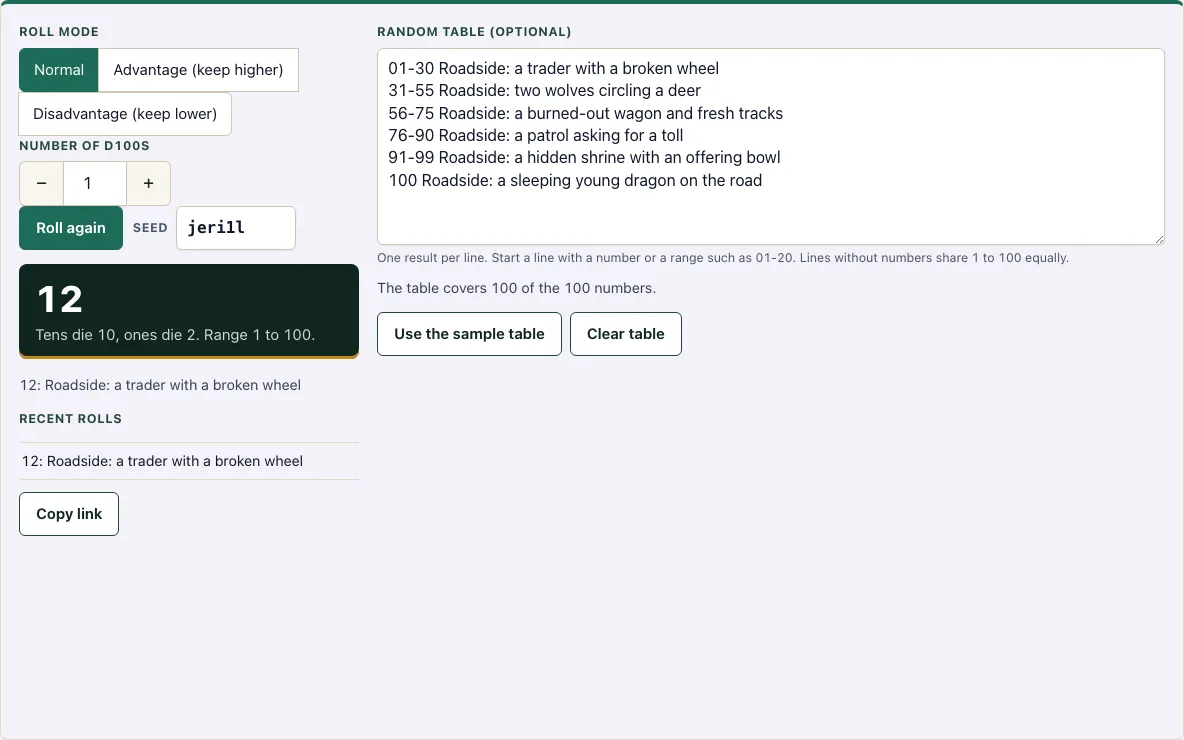
How to use the d100 roller
- Choose a Roll mode. Normal rolls one d100. Advantage (keep higher) rolls two and keeps the higher number. Disadvantage (keep lower) rolls two and keeps the lower one.
- Set the Number of d100s with the stepper. It goes from 1 to 20.
- Optional: paste your lines into the Random table (optional) box, one result per line. Press Use the sample table to load a six-line example, or Clear table to empty the box.
- Optional: edit the seed box (letters or digits) if you want a roll you can repeat later. Press Roll again to roll with your current settings.
- Read the result. A single roll shows a large number, a line such as “Tens die 40, ones die 7”, and a note that 00 and 0 read as 100. If a table is filled in, its matching line appears under the result.
With several dice, the result lists the sum, the average, the lowest and the highest, then every number as a chip with its table line beside it. Copy link saves your mode, count, seed and table in the page address, so you can send someone the same setup. Recent rolls keeps the last 10 results from your visit, and nothing is sent to a server.
How do you roll a d100 with two dice?
Rolling a d100 with two dice means rolling two ten-sided dice and reading them together. Read one as the tens digit, from 00 up to 90 in steps of ten. Read the other as the ones digit, from 0 to 9. Combine them to get a number from 1 to 100.
- Roll the tens die and read it as 00, 10, 20 through 90.
- Roll the ones die and read it as 0 through 9.
- Add the two readings. If both show zero (00 and 0), the result is 100, not zero.
- Example: a tens die of 40 and a ones die of 7 make 47.
Each of the 100 pairings is equally likely, so every number has a 1 in 100 chance, and a single d100 averages 50.5. The roller does these steps for you and shows both readings with each result.
How do I use a d100 random table?
A random table is a list where each line starts with a number or a range and ends with a result. Your d100 result picks the line that covers it, so a table is an easy way to turn one roll into an outcome. Lines beginning with a single number, such as “61 Ogre”, cover only that number. A range such as “62-00 Nothing” covers 62 to 100, because 00 at the end of a range means 100.
- Write each line as a number or range followed by the result, for example: 01-20 Goblins, 21-60: Wolves, 61 Ogre, 62-00 Nothing.
- Paste the lines into the Random table (optional) box. Each line counts as one result.
- Roll. The matching line appears under the result, for example “47: …”.
- Read the coverage report: how many of the 100 numbers are covered, plus any gaps or overlaps.
Lines without numbers share 1 to 100 equally. Four such lines get 25 numbers each, and three lines get 34, 33 and 33. The sample table covers every number once:
| Sample line | Numbers covered | How many numbers |
|---|---|---|
| 01-30 | 1 to 30 | 30 |
| 31-55 | 31 to 55 | 25 |
| 56-75 | 56 to 75 | 20 |
| 76-90 | 76 to 90 | 15 |
| 91-99 | 91 to 99 | 9 |
| 100 | 100 | 1 |
How this tool works and where the numbers come from
The roller draws a tens die (00 to 90) and a ones die (0 to 9) with a seeded random generator and adds them; 00 and 0 read as 100, so each of the 100 results has a 1% chance. Advantage and disadvantage keep the higher or lower of two rolls. Table lines are matched to the result by number range.
Sources
- Wizards of the Coast (2025). SRD 5.2.1, random tables that use 1d100 (Trinkets, Magic Items). Licensed CC-BY-4.0 (SRD v5.2.1 (published 2025-05-01); page last updated 2026-03-02) · checked
- Wizards of the Coast (2025). SRD 5.2.1, PDF edition (SRD 5.2.1) · checked
Frequently asked questions
Is a d100 the same as percentile dice?
Usually, yes. Percentile dice means a result from 1 to 100, and most tables mean two ten-sided dice read together. Some sets include a single 100-sided ball, which gives the same range.
What does 00 mean on percentile dice?
On the tens die, 00 is the zero face and reads as 0 tens. When both dice show zero, the result is 100, not zero. This roller shows a note saying 00 and 0 read as 100.
How do you roll a d100?
With one physical d100 ball, roll it once and read the number on top. With two ten-sided dice, roll the tens die and the ones die, then add the readings. On this page, press Roll again to roll one on screen.
How do I roll a d100 with advantage or disadvantage?
Set Roll mode to Advantage (keep higher) or Disadvantage (keep lower). The roller rolls two d100 and keeps one, and its note names both numbers and the one kept.
What is the average of a d100?
A single d100 averages 50.5, and each number from 1 to 100 has a 1% chance, so a result of 30 or less is 30%. With advantage it averages 67.2, and with disadvantage it averages 33.8 (exact values 67.165 and 33.835).
Can I roll several d100 at once?
Yes. Set Number of d100s from 1 to 20. The result then shows the sum, average, lowest and highest, and every number as a chip with its table line.
Can the roller handle a table with gaps or overlaps?
Yes. It reports how many of the 100 numbers your table covers, lists uncovered numbers as gaps, and lists numbers covered by more than one line as overlaps. For an overlap, the first matching line is used. Lines it cannot read are skipped and counted.
What uses a d100 in D&D?
Random encounter tables, treasure tables, trinket tables and wild magic effects all commonly use a d100. Paste the table into the random table box to get the matching entry for each roll.
Related tools
- Dice roller: use it for dice other than a d100, such as d6 or d20 rolls.
- Stat roller: use it when you need to roll a set of character ability scores.
- Random encounter generator: use it when you want an encounter without building your own table.
- Loot generator: use it to roll treasure from a ready-made list.
- Magic item generator: use it to roll a random magic item for a game.
- Quest generator: use it to roll a quest hook when you need an idea for the table.
- Damage calculator: use it to check the average damage of a dice expression such as 8d6.