
DnD Alignment Chart Test
Rate sixteen statements to find your spot on the nine-alignment chart.
Recent
Your last 10 settings, saved only in this browser. Nothing is uploaded.
How to use the Alignment test
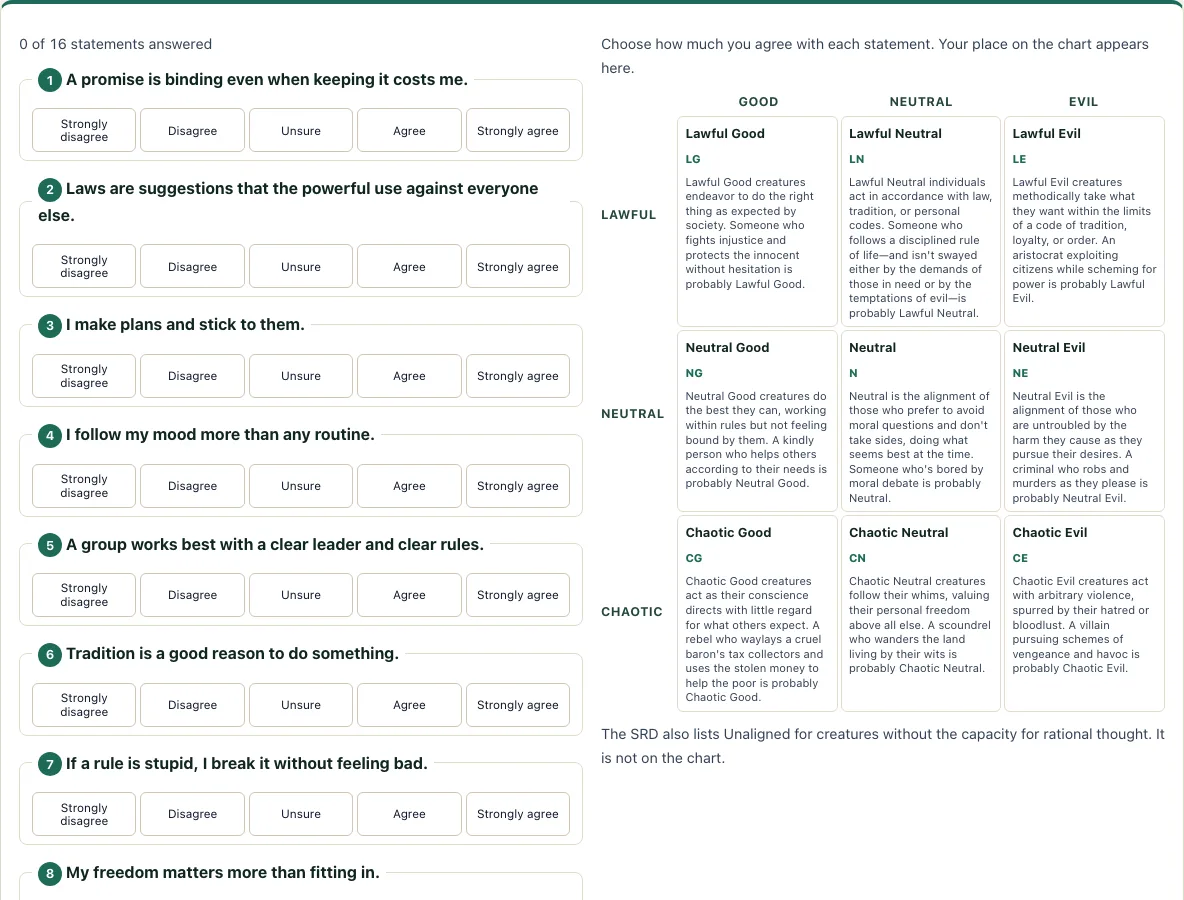
- Read the first statement and tap one of the five answers: Strongly disagree, Disagree, Unsure, Agree, or Strongly agree. The buttons are large, so they are easy to tap on a phone.
- Answer the next statement. The counter at the top shows “N of 16 statements answered,” so you can track your progress.
- Watch the red dot on the 3x3 chart. It moves after every answer, so you can see how each choice shifts your result.
- If you cannot decide on a statement, leave it unanswered and move on. You can return to it later.
- When you have answered all sixteen, read the result: the alignment name in large type, its abbreviation, the SRD description, and the dot’s final position on the chart.
The cell you land in is outlined in gold, and the other eight stay plain, so the result is clear at a glance. Your answers stay selected while you scroll, and you can change any of them by choosing another button.
Press Copy link to save your answers. The button stores them in the address, so you can share the link or come back to the same result later. Press Start again to clear every answer and begin a new test.
What are the nine alignments in 5e?
The 9 different alignments in Dungeons & Dragons are Lawful Good (LG), Neutral Good (NG), Chaotic Good (CG), Lawful Neutral (LN), Neutral (N), Chaotic Neutral (CN), Lawful Evil (LE), Neutral Evil (NE), and Chaotic Evil (CE). Each one combines a position on the law-chaos axis with a position on the good-evil axis.
What is the alignment chart?
The alignment chart is a 3x3 grid. Its rows are Lawful, Neutral, and Chaotic, and its columns are Good, Neutral, and Evil. Each cell is one of the nine alignments.
The test places you on this grid using two scores, each running from -100 to +100. Each score is the average of eight answers, signed so that agreeing moves you toward lawful or good. A score between -33 and +33 counts as neutral on that axis. Beyond +33 or -33, you leave neutral and move toward that side. Your two results together decide which cell you land in.
What does lawful good mean?
Lawful Good means a character who tries to do the right thing as society expects. The SRD says Lawful Good creatures endeavor to do the right thing as expected by society. “Lawful” points to rules, order, and duty, while “good” points to kindness and care for others. A character with this alignment usually respects laws and works to protect people within them.
What is chaotic neutral?
Chaotic Neutral means a character who follows their own whims and puts personal freedom above everything else. The SRD describes Chaotic Neutral creatures as valuing their personal freedom above all else. They do not care much about rules, and they are not driven by a clear moral side. A chaotic neutral character may be unpredictable, but they are not necessarily cruel.
What is true neutral?
True neutral is the common name for the Neutral (N) alignment at the center of the chart. The SRD describes it as the alignment of those who prefer to avoid moral questions and don’t take sides. Neutral characters are not indifferent to everything. They simply do not commit to a moral or lawful side in most situations.
What is unaligned?
Unaligned is a category for creatures without the capacity for rational thought, such as sharks. The SRD lists it separately, and it is not one of the nine cells on the chart. The alignment test does not produce an unaligned result, because it is designed for characters who can make moral choices.
Do you have to pick an alignment?
No. The SRD 5.2.1 describes alignment as a short description of attitude and behaviour, given as a step in character creation (p. 21). It is not a rule that limits what a player may do. The alignment test is meant for fun and as a starting point for roleplay, so you can keep, change, or ignore the result as your story requires.
Frequently asked questions
Is the alignment test free?
Yes. It is free to use, requires no account or sign-up, and runs entirely in your browser. Your answers are not uploaded anywhere.
How many statements are there?
There are sixteen. Eight measure law versus chaos, and eight measure good versus evil, so each axis gets an equal share of the questions.
What happens if I skip a statement?
Unanswered statements count as neutral. The result updates after every answer, and the counter shows how many of the sixteen you have answered.
What do the scores from -100 to +100 mean?
Each score shows how strongly your answers lean toward one side of an axis. Scores between -33 and +33 stay neutral, while scores beyond them move you toward lawful or good, or toward chaotic or evil.
Can I use the result for a character who does not match it?
Yes. Treat the result as a starting point and adjust it to fit your character’s story and your group’s style of play.
Does the test work on a phone?
Yes. The buttons are large touch targets, and the layout fits a 375 px screen.
How do I share my result?
Press Copy link. The button stores your answers in the address, so you can send that link to someone else.
Related tools
- Character creator: Build a full character step by step once you know your alignment.
- Class quiz: Find a class that suits the personality your alignment suggests.
- Character sheet: Record your alignment and other details in one place for play.
- Stat roller: Generate ability scores that fit the character you have in mind.
- Point buy calculator: Spend a fixed pool of points on ability scores as an alternative to rolling.
- Languages: Choose the languages your character speaks based on their background.
- HP calculator: Work out hit points once your class and Constitution are set.
- Spell list: Browse spells to match your character’s class and playstyle.